Important: This article provides general educational information about orthodontic treatment options. It is not a diagnosis, treatment recommendation, or substitute for professional dental or medical advice. Every patient's situation is different -- oral health, bite issues, and age all influence which option is appropriate. Always consult a licensed orthodontist or dentist before making any treatment decision.
Invisalign and traditional braces are both orthodontic systems designed to move teeth into better alignment over time. The right choice between them depends on your specific clinical case and what your orthodontist determines is best suited to your anatomy, goals, and lifestyle -- not on any general preference. This guide covers how each system works, what they tend to cost, how they differ in daily use, and the kinds of questions that are worth raising at a consultation.
How Each System Works
Traditional metal braces consist of metal brackets bonded to the front surface of each tooth, connected by an archwire that is periodically tightened or adjusted. The wire applies controlled, continuous pressure to guide teeth into their target positions over time. Brackets may be metal (the most common) or ceramic -- which are tooth-colored and less visible but work on the same mechanical principle. Periodic appointments, typically every four to eight weeks, allow the orthodontist to change wires and make progress checks.
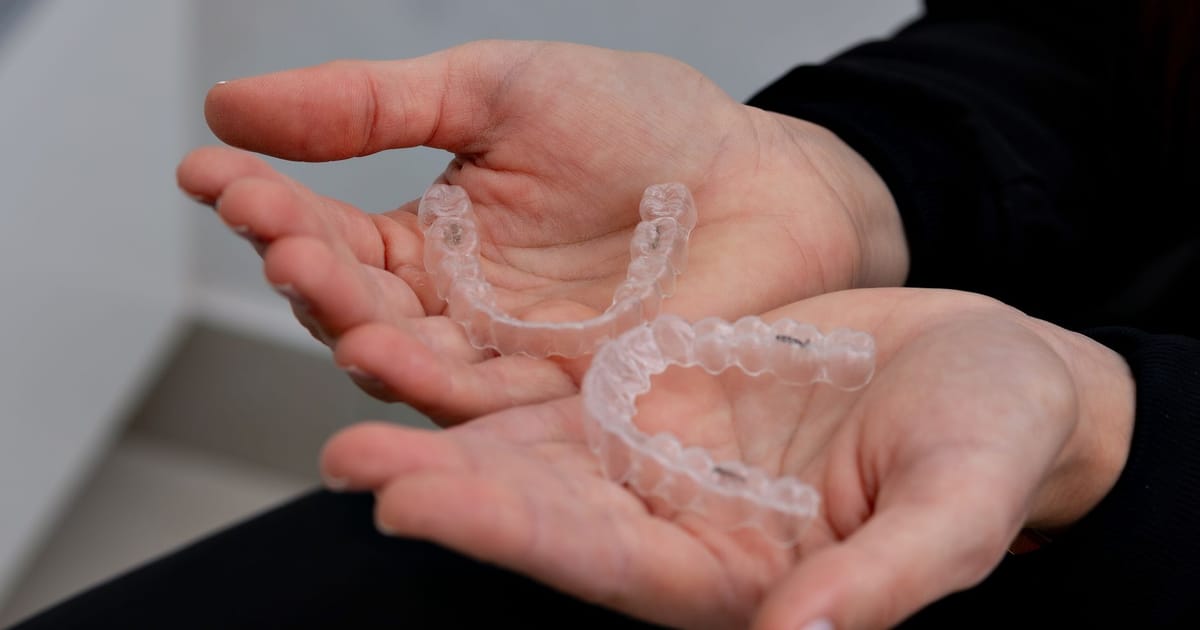
Invisalign -- and clear aligner therapy more broadly -- works differently. A series of custom-fabricated, removable plastic trays (aligners) are made from a 3D scan or mold of the patient's teeth. Each tray in the series is slightly different from the last, exerting incremental pressure to shift teeth gradually. Patients typically move to a new tray every one to two weeks, with check-in appointments scheduled less frequently than with braces -- often every six to ten weeks, according to the American Association of Orthodontists. Small tooth-colored attachments called "buttons" are sometimes bonded to teeth to give the aligners additional grip for more complex movements.
Both systems rely on the same underlying biological process: applying sustained, calibrated force to stimulate bone remodeling around the tooth root, allowing teeth to shift. The appliance type changes the mechanics of how that force is delivered, not the biology itself.
Consult your orthodontist: Only a licensed orthodontist can evaluate whether your specific case is a good candidate for clear aligner therapy, traditional braces, or a combination approach. A clinical examination -- including X-rays and photographs -- is necessary before any recommendation can be made.
Effectiveness and Case Complexity
The clinical evidence for both systems' ability to correct mild to moderate crowding, spacing, and some bite issues has grown substantially. The American Association of Orthodontists notes that orthodontic treatment outcomes depend heavily on the type and severity of the tooth and jaw problem being addressed, regardless of the appliance used.
Traditional braces have a longer clinical track record and are generally considered effective across a broader range of case complexity. They provide continuous, around-the-clock force without requiring patient cooperation in keeping them in -- because they are fixed. Complex bite corrections, significant rotations, and cases requiring tooth extractions have historically been managed more predictably with fixed appliances, though individual provider experience and case specifics matter greatly.
Clear aligners have become more capable over time. Research published in the American Journal of Orthodontics and Dentofacial Orthopedics has found that clear aligners can produce outcomes comparable to fixed appliances in certain case categories, particularly mild to moderate crowding and spacing. However, that same body of literature also notes that very complex cases -- including significant skeletal discrepancies, severe rotations, or extensive vertical corrections -- may not be optimally managed by aligners alone.
The critical point here is that case-by-case assessment matters far more than any general comparison. A case that is straightforward for aligners in one patient may be complex in another, depending on root morphology, bone quality, compliance, and other factors only visible through clinical evaluation. Statements like "aligners can treat everything braces can" or "braces are always better for complex cases" both oversimplify a clinical picture that your orthodontist is best placed to read.
Cost and Insurance
Orthodontic costs vary substantially by case complexity, treatment length, provider, and geographic location. The American Dental Association notes that orthodontic fees are typically set to reflect the clinical time and expertise required for a given case, which means two patients with different severity levels can expect meaningfully different costs even within the same practice.
For reference, the American Association of Orthodontists has noted that the national average cost of braces ranges broadly, and Invisalign treatment is frequently priced in a similar or somewhat higher range depending on case complexity and provider pricing policies. These are approximations -- actual quotes come from your specific orthodontist after an examination. See How Much Do Braces Cost in the US? for a more detailed breakdown of typical ranges and what drives cost variation.
| Factor | Invisalign (Clear Aligners) | Traditional Braces |
|---|---|---|
| Average treatment duration | Varies by case; often 12-24 months for moderate cases | Varies by case; often 18-24 months for moderate cases |
| Typical cost range (national) | Varies; often similar to or slightly above braces | Varies; typically lower to mid-range depending on case |
| Insurance coverage | Often covered up to plan's orthodontic maximum | Often covered up to plan's orthodontic maximum |
| Requires removal to eat | Yes | No |
| Fixed to teeth | No | Yes |
| Visibility | Low (nearly transparent) | Moderate (metal) to low (ceramic) |
| Adjustment appointments | Less frequent (every 6-10 weeks typically) | More frequent (every 4-8 weeks typically) |
Most dental insurance plans that include orthodontic benefits apply a lifetime orthodontic maximum to either braces or Invisalign -- the appliance type typically does not affect eligibility. However, what is covered, at what percentage, and subject to what waiting periods differs by plan. Review your Explanation of Benefits or call your insurer directly, and confirm with your orthodontist's billing team before making financial decisions. If you are uninsured, the cost of dental care without insurance guide covers options that may reduce out-of-pocket orthodontic expenses.
Flexible spending accounts (FSAs) and health savings accounts (HSAs) can typically be used toward orthodontic treatment costs -- confirm eligibility with your plan administrator.
Financial planning note: Get a written treatment plan and fee breakdown from your orthodontist before committing. Ask specifically what happens if the case takes longer than initially planned and whether refinements (additional aligners) are included in the Invisalign fee, since practices differ on this point.
Comfort, Lifestyle, and Compliance
Traditional braces are fixed appliances -- they remain on the teeth for the duration of treatment. This means they work continuously without any action on the patient's part, but it also means they impose constraints that cannot be opted out of. Foods that are hard, sticky, or chewy -- such as popcorn, caramel, hard nuts, and certain raw vegetables -- are typically restricted because they risk bending wires or dislodging brackets. The brackets and wires can cause soft-tissue irritation, particularly in the early weeks and after adjustments, and some patients use orthodontic wax to reduce friction against the inner cheeks.
The American Association of Orthodontists notes that soreness after wire adjustments is normal and generally resolves within a few days. Over-the-counter pain relievers, used as directed, are commonly recommended for this period.
Clear aligners are removable, which changes the comfort and lifestyle equation in both directions. On the one hand, patients can remove them to eat, meaning no food restrictions apply -- dietary habits do not need to change during treatment. Oral hygiene routines are also easier because aligners come out for brushing and flossing. On the other hand, the aligners must be worn for the recommended amount of time -- the American Association of Orthodontists cites guidance of approximately 20 to 22 hours per day -- for treatment to progress as planned. Patients who remove aligners more frequently than recommended may see slower or less predictable progress.
This compliance factor is clinically significant. For motivated patients who consistently wear aligners as directed, the system can work well. For patients who anticipate difficulty maintaining that schedule -- whether due to work, social situations, or general habit -- fixed braces eliminate the variable entirely.
Aligner trays can cause a slight pressure sensation when a new set is introduced, and some patients report temporary changes in speech, such as a mild lisp, that typically diminish as the mouth adapts to each new tray.
Maintenance, Hygiene, and Appointment Schedules
Maintaining good oral hygiene is important during any orthodontic treatment. The mechanics differ between the two systems.
With traditional braces, brushing and flossing require extra attention because brackets and wires create more surfaces where food particles and plaque can accumulate. Orthodontic-specific tools -- such as floss threaders, interdental brushes, and water flossers -- can help reach areas that are otherwise difficult to clean. The American Dental Association emphasizes that inadequate oral hygiene during orthodontic treatment can contribute to decalcification (white spots on enamel), cavities, and gum inflammation. Regular cleanings with a dentist or hygienist are especially important during this period. See how often to see a dentist for general guidance on appointment frequency.
Clear aligners are removed for brushing and flossing, making the hygiene routine closer to the patient's normal baseline. However, the trays themselves require cleaning -- rinsing with water and brushing gently each time they are removed -- to prevent bacterial buildup and discoloration. Eating or drinking anything other than plain water with aligners in can stain the trays and create an environment that increases cavity risk.
Appointment frequency differs as well. Traditional braces typically require in-office visits every four to eight weeks for wire adjustments and progress checks. Clear aligner treatment often involves less frequent in-person appointments -- frequently every six to ten weeks, with some practices supplementing with remote monitoring tools -- though this varies by provider and case complexity.
Talk to your orthodontist and dentist: During orthodontic treatment, regardless of which appliance you use, maintain your regular dental cleanings and check-ups. Orthodontists manage tooth movement; your general dentist manages overall oral health, including cavity prevention, during the same period. Both relationships matter. Use how to choose a dentist if you are not yet established with a general dental provider.
Who Each Option Tends to Suit
Neither option is universally better for all patients. The following reflects general patterns discussed in orthodontic literature and clinical guidance from the American Association of Orthodontists -- not a recommendation for any individual reader.
Traditional braces may be more commonly recommended in cases involving:
- Significant overcrowding or complex tooth rotations
- Moderate to severe bite discrepancies (overbite, underbite, crossbite) with a meaningful skeletal component
- Younger patients or patients where compliance with a removable device would be a concern
- Cases requiring tooth extractions as part of the treatment plan
- Situations where precise control of three-dimensional tooth movement is particularly important
Clear aligners tend to be well-suited to cases involving:
- Mild to moderate crowding or spacing
- Adult or older teen patients who place significant value on aesthetics during treatment
- Patients who can reliably maintain the required daily wear schedule
- Cases where treatment monitoring via intraoral scans has advantages for tracking progress
It is worth emphasizing again that this list describes tendencies in clinical practice, not rules. A case that looks like an aligner candidate on paper may have clinical nuances -- root morphology, periodontal health, skeletal factors -- that make braces more appropriate. Only a clinical examination and imaging can determine this.
What to Ask at Your Orthodontic Consultation
Knowing what questions to raise can help you get the most out of an initial evaluation. The American Association of Orthodontists recommends that patients seek a consultation when they have concerns about tooth alignment or bite, and notes that orthodontists often offer complimentary initial examinations.
Questions worth considering:
- Is my case a candidate for clear aligners, traditional braces, or either?
- What is the anticipated treatment duration for my case, and what factors could extend it?
- What does the total fee include -- and what is not included (refinements, retainers, emergency visits)?
- Does my dental insurance apply toward this treatment, and what is the expected out-of-pocket cost?
- How often will I need to come in for appointments?
- What happens if I lose or damage an aligner tray?
- Will I need retainers after treatment, and what do they cost?
Asking about the orthodontist's experience with your specific type of case -- not just with aligners or braces in general -- is reasonable, particularly if you have been told your situation is complex.
Making a Decision That Is Right for You
Invisalign and traditional braces are both established orthodontic approaches with meaningful clinical track records. Neither is inherently superior. The right choice for any individual depends on clinical factors -- case complexity, bite structure, bone and root anatomy -- alongside practical considerations like compliance capacity, lifestyle, and cost.
Patients who choose based on aesthetics alone (wanting to avoid visible hardware) may find that their clinical situation makes braces the more appropriate tool. Patients who believe braces are always the "safer" choice may find that their mild case is well within what aligners can comfortably address.
The decision is best made after a thorough evaluation by a licensed orthodontist who can examine your teeth and bite in person, review X-rays, and explain the treatment plan in terms specific to your anatomy. No article -- including this one -- can replicate that assessment.
Talk to your orthodontist: If you are considering orthodontic treatment, schedule a consultation with a licensed orthodontist. An in-person evaluation is the only way to determine which option is appropriate for your clinical situation. If cost is a concern, ask about payment plans, insurance coordination, and whether the practice offers a complimentary initial exam.
For more on what drives orthodontic costs, see How Much Do Braces Cost in the US?. If you are navigating dental care without insurance coverage, cost of dental care without insurance covers options that may help with access and affordability.
This guide is for general informational purposes only. It does not constitute medical or dental advice, a diagnosis, or a treatment recommendation. Consult a licensed orthodontist or dentist for evaluation and guidance specific to your situation.
Frequently asked questions
Is Invisalign faster than traditional braces?
Treatment duration depends on the complexity of each patient's case, not the appliance alone. According to the American Association of Orthodontists, mild to moderate cases may complete in 12 to 18 months with either method, while complex cases often take longer. Your orthodontist will give you a case-specific estimate after a clinical evaluation.
Is Invisalign more expensive than braces?
Costs vary by case complexity, geographic location, and provider. The American Dental Association notes that orthodontic fees reflect the length and difficulty of treatment. Both options may be partially covered by dental insurance plans with orthodontic benefits. A detailed cost breakdown requires a consultation with a licensed orthodontist.
Can Invisalign fix severe bite problems?
Clear aligners have expanded considerably in what they can address, but some complex bite issues -- such as significant skeletal discrepancies or severe crowding -- may be better managed with traditional braces or a combination of appliances. Your orthodontist is the appropriate person to assess which option fits your clinical situation.
Do braces or Invisalign hurt more?
Discomfort patterns differ between the two. Traditional braces may cause soreness after wire adjustments; clear aligners may cause pressure when a new tray is first worn. The American Association of Orthodontists notes that mild discomfort is a normal part of orthodontic movement with either method. Both are generally manageable with over-the-counter pain relievers if needed.
Will insurance cover Invisalign or braces?
Many dental insurance plans with orthodontic benefits apply a lifetime orthodontic maximum -- typically ranging from $1,000 to $2,000 -- toward either braces or Invisalign, though coverage terms vary by plan. Review your specific policy and confirm coverage with both your insurer and your orthodontist's billing office before starting treatment.